The 228 domestic wells on file within 5 miles of Karns City, from the state’s drilling logs: your neighbors’ wells, and the best guide to this ground.
Source: PaGWIS (PA DCNR), domestic wells within 5 miles, retrieved 2026-09-30; older paper-record locations are approximate.
Narrow Ranges in the Local Logs
The logs around Karns City don’t stray far. Among the 148 that note bedrock, half reached it within 15 feet and three in four within 20, so casing, which usually runs down to rock, likely changes little from lot to lot. Among the 219 that record yield, three in four gave 10 gallons per minute or more.
For a homeowner, that means a new well’s plan starts on firmer footing: a likely depth, a short casing, and a yield that supports a normal household in most cases. The final depth is still settled while drilling and the pump chosen after the yield test, but the surprises tend to be smaller. Depth leads the list in what a new well costs, and residential well drilling sets out each step.
Allegheny Rock and a 20-Gallon Median
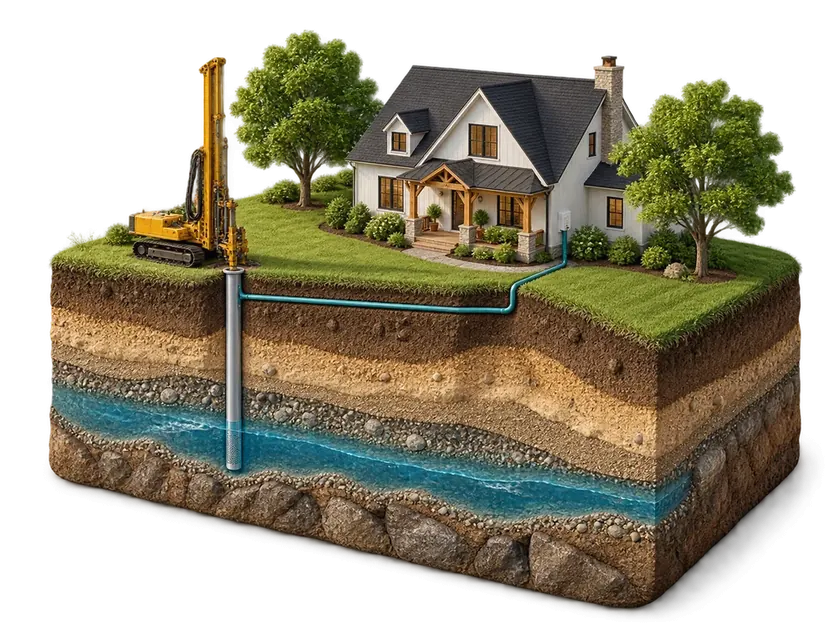
Under the town, geologic maps show the Allegheny Formation, with Pennsylvanian sandstone, shale, limestone, clay and coal in its layers. Its water moves along fractures and bedding, and the driller’s log marks the depth of each water-bearing zone.
The median yield of 20 gallons per minute leaves room in the pump choice. A submersible pump can be picked for the household’s needs without the well limiting it, and a pressure tank sized with it spaces out the starts that wear a pump. The quarter of wells at 10 gallons per minute or less take the other approach, a pump matched to recovery so it doesn’t outrun the well. Your own yield test shows which you have.