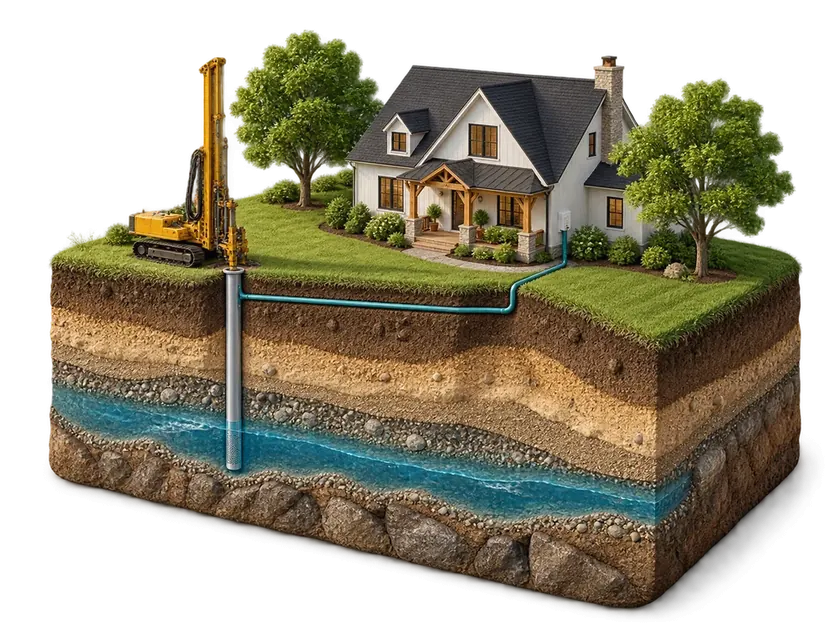
The 1,269 domestic wells on file within 5 miles of McKean, from the state’s drilling logs: your neighbors’ wells, and the best guide to this ground.
Source: PaGWIS (PA DCNR), domestic wells within 5 miles, retrieved 2026-09-30; older paper-record locations are approximate.
Predictable Depth, Uneven Flow
The McKean figures rest on a large sample: 1,269 logs that record a depth and 1,164 that record a yield. Depth barely strays. A quarter of wells stopped at 50 feet or less and a quarter went to 72 or more, and by median the town ties for 7th of 16 in Erie County, squarely mid-county.
Yield strays a lot. A well of typical depth can still come in at 3 gallons a minute or less, which is why the pump is picked from the flow test. On a slow well the submersible pump is rated under the tested flow so it never out-draws the ground, and a pressure tank limits how often it starts. On an existing well, a well inspection checks the flow, the pump and the tank before anything changes.
Erie City Water and Its Lead Record
The Erie City Water Authority treats surface water drawn from Lake Erie and Presque Isle Bay for 63,820 connections. Among the steps EPA lists are an orthophosphate inhibitor, added to protect pipes from corrosion, along with filtration, chlorine and fluoride. Homes on its lines get their water report from the authority.
EPA's lead 90th percentiles for the system were 0.00118 mg/L for the round ending 2016, recorded as zero for 2019, and 0.00108 for both 2022 and 2025, every one under the 0.015 action level. The result is measured across taps in the service area, and one home's can differ. A home test settles it, and reverse osmosis at the kitchen sink is the usual answer if lead turns up. For private wells, see Erie County water treatment.