The 955 domestic wells on file within 5 miles of Saxonburg, from the state’s drilling logs: your neighbors’ wells, and the best guide to this ground.
Source: PaGWIS (PA DCNR), domestic wells within 5 miles, retrieved 2026-09-30; older paper-record locations are approximate.
Short Bores, Good Flow
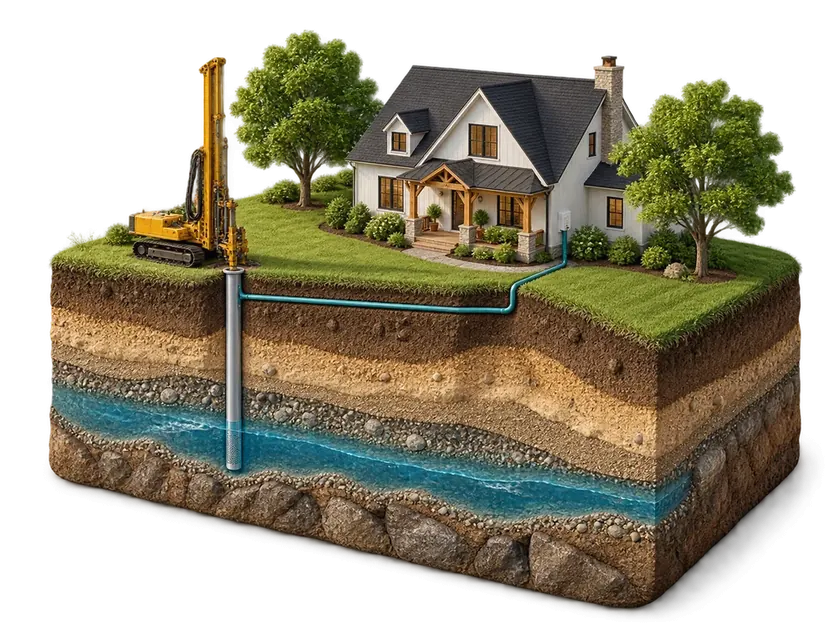
Wells around Saxonburg don’t usually go far. Of 955 depth logs, a quarter stopped at 94 feet or less and three in four by 167. The yields hold up at those depths: of the 908 logs that record it, half gave 20 gallons per minute or more.
Fewer feet drilled usually means a smaller bill, and a well that gives freely leaves room in the pump choice. The town center is mapped on the Glenshaw Formation: Pennsylvanian shale, coal, sandstone and limestone. The soil over it varies, from a few feet on some lots to 26 or more on others. What a new well costs breaks down depth and casing, and residential well drilling covers each step of the job.
Softened Water on the Butler System
On EPA’s service-area map, Saxonburg’s center falls within Pennsylvania American Water’s Butler system. It draws on Oneida Reservoir, Thorn Run Reservoir and the Allegheny River, and buys filtered water from the company’s Ellwood City system. EPA lists ion exchange softening among its treatment steps, so water on those mains is softened at the plant. The list also includes lime and soda ash, a polyphosphate corrosion inhibitor, and chloramine.
For homes on the mains, chloramine is the one to know about: it lasts in the pipes and passes through a softener, and a CityLux system removes it. Lead in the system’s four sampling rounds was under the 0.015 mg/L action level each time. Homes on private wells start instead with a water test.